

This year the tech industry faced big changes: DORA regulations went into effect, the increasing adoption of AI and AI agents, and major outages. As our State of Resilience Report found earlier this year, organizations experience on average 86 outages each year. Within just one month, we saw critical services falter as AWS, Azure, and Cloudflare grappled with downtime. In 2025, the everyday consumer felt firsthand the impact of those outages: sites like X and ChatGPT malfunctioned, airlines suffered, and customer trust eroded.
With this backdrop, at Cockroach Labs, 2025 was a year focused on scaling the state-of-the resilience and defense in depth we have become known for, and building for a future of agentic AI. The company welcomed our new Chief Financial Officer, Sailesh Munagala, published the 2nd edition of O’Reilly’s CockroachDB: The Definitive Guide, celebrated our 10-year anniversary, took our annual database conference global, launched a novel performance benchmark for databases, continued to partner with industry giants like IBM, released a lot of new customer-driven features, and almost doubled product performance. This was a big year for Cockroach Labs. Our achievements were made possible by our global team, so let’s take a look back on what we’ve accomplished together, and look ahead to what is to come in 2026.
Performance under Adversity: Database benchmarking for the future
In May of this year, our team launched a brand new benchmark for databases: “Performance under Adversity.” The team reimagined the decades-old TPC-C industry-standard benchmark in order to measure resilience and put our own database through the scrutiny our customers deserve. In 2025 and beyond, customers need to know that their infrastructure will continue performing even when things fail. Particularly with outages on the rise, the only guarantee today is that something will always fail, something will always stress the system. Whether it's routine maintenance or a regional outage, we believe that you should know if your infrastructure can survive.
The team identified seven increasing levels of failures to truly evaluate database performance:
Baseline Performance: Measure steady-state throughput under normal conditions.
Internal Operational Stress: Simulate resource-intensive operations such as change data capture, full backups, schema changes, and rolling upgrades.
Disk Stalls: Randomly inject I/O freezes to evaluate storage resilience.
Network Failures: Simulate partial and full network failures preventing one partition from communicating with nodes in another partition.
Node Restarts: Unpredictably reboot database nodes (1 at a time) to test recovery time and impact to performance.
Zone Outages: Take down an entire Availability Zone.
Regional Outages: Take down an entire Region.
Benchmarking against the field
Over time, as we tested new versions we saw great improvements in resilience with latency decreasing by a factor of 10 and with residual latency spikes due to failures almost eliminated. Additionally, we began running our competitors through the same tests, and found that CockroachDB offers over 5x the resilience of Oracle GDD, Oracle’s distributed database. (NOTE: We tested CockroachDB v25.3 against Oracle GDD 23ai. 23ai is the first version of Oracle that can support GDD in a Raft configuration. The results are accurate as of September 2025.)
We also benchmarked other databases based on their architecture, resilience, scalability, ease of migration, Postgres compatibility, customer experience and more. You can learn more about how we stack up against Oracle GDD, AWS Aurora (Global Database & DSQL), Yugabyte, and other databases on our comparison page.
We hope that the longer we continue to put CockroachDB to the test, our peers and competitors will put their products through a similar level of rigor so that users feel confident in their infrastructure.
Scaling state-of-the-art resilience and defense in depth
In 2025, Cockroach Labs delivered one of its most ambitious years of product innovation yet, advancing the state of distributed SQL with a clear focus on performance, resilience, and enterprise-grade security. By the mid-year point with 25.2, we had introduced performance boosts of up to 50%, dramatically reduced downtime with features like leader leases and buffered writes, and brought PostgreSQL-compatible vector indexing to market for AI-powered applications.
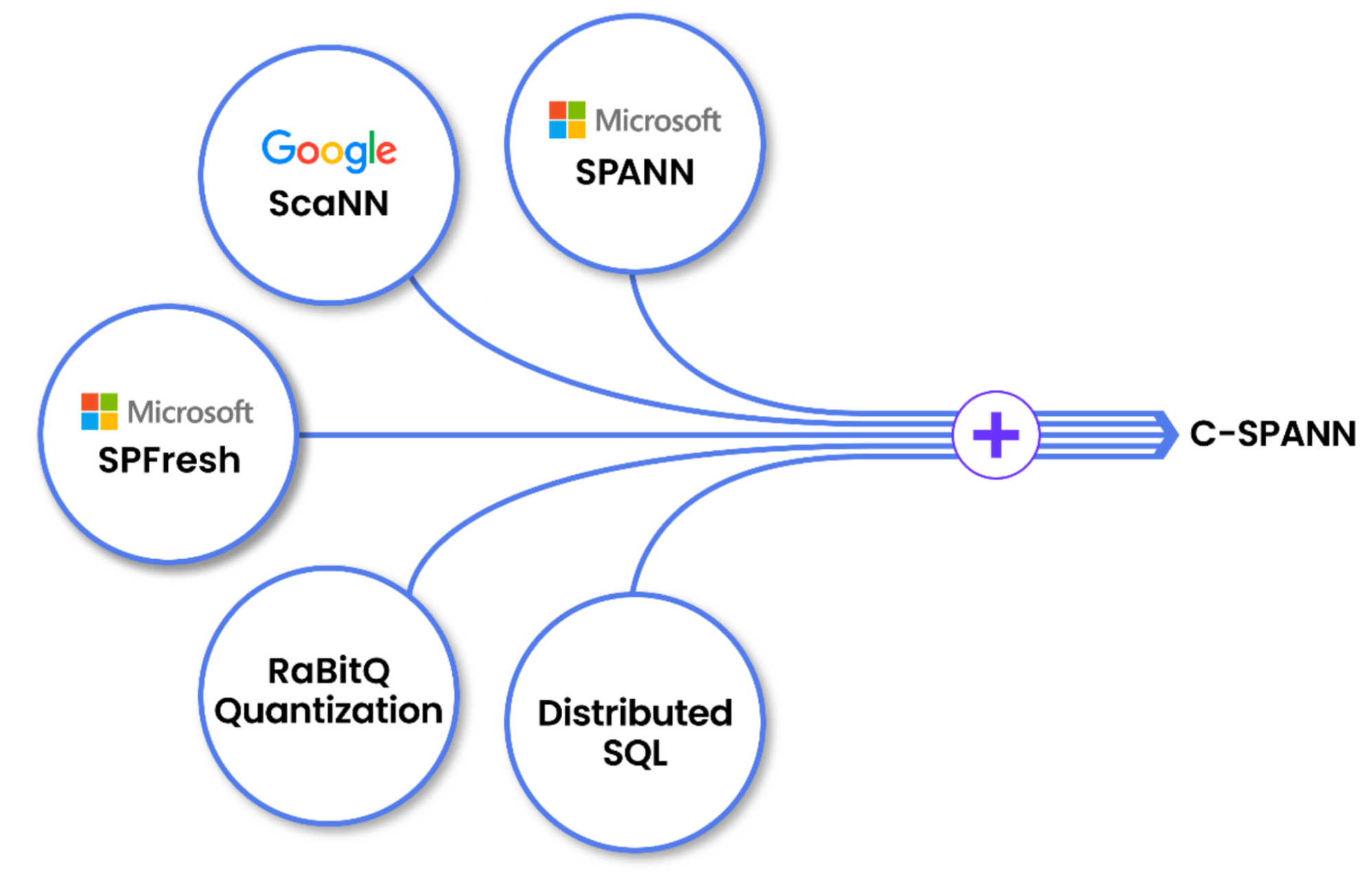
C-SPANN (CockroachDB SPANN) represents a major innovation in vector indexing, not simply because it’s fast, but because it’s fundamentally aligned with the demands of distributed SQL. Unlike most vector search systems, which rely on centralized coordination, static indexes, or large in-memory structures, C-SPANN was built from the ground up to deliver accurate, low-latency, and fresh search results at scale, without sacrificing resilience, geo-partitioning, or operational simplicity. Its quantization approach (via RaBitQ) reduces index size by up to 94%, making real-time updates and background operations efficient even under load. Critically, C-SPANN avoids coordination bottlenecks and works with CockroachDB’s built-in multi-region architecture, making it the only vector indexing solution that’s truly native to distributed SQL. Today, C-SPANN makes it possible to index and search billions of vectors in real time, unlocking new use cases for AI and semantic search at scale.
Enterprise resilience also leveled up with WAL failover, a new mechanism that redirects write-ahead logs to a secondary disk during transient (but common) cloud storage stalls. Instead of suffering seconds-long latency or unnecessary node removals, CockroachDB continues operating smoothly, keeping write availability intact with minimal impact to performance.
At the same time, we deepened our commitment to enterprise-readiness with the general availability of row-level security, allowing fine-grained access controls directly in the database, a critical step for industries like healthcare, finance, and SaaS multi-tenancy. And with the new Kubernetes operator in public preview, managing multi-region, zero-downtime deployments in Kubernetes environments is now simpler, safer, and more flexible.
Additionally, as the demands for modernization, scale, resilience, and speed rise, we made it even easier for organizations to migrate to CockroachDB. We know database migration can be a risky process, so we continued improving our MOLT (Migrate Off Legacy Technology) toolkit to simplify and streamline migrations. This year, we added support for organizations to migrate their data from Oracle to CockroachDB, allowing companies to modernize their data infrastructure even more easily.
Combined with compliance milestones like HIPAA readiness on Azure and private egress support in CockroachDB Cloud, 2025 proved to be a defining year for the database built to scale fast, survive disaster, and thrive everywhere.
Modernizing data infrastructure together: IBM OEM, ISV partnerships, and RoachFest
2025 also marked a significant expansion in Cockroach Labs’ partner ecosystem. IBM and Cockroach Labs announced our OEM partnership, bringing the resilience and scale of distributed SQL to IBM clients. This collaboration reinforces the growing demand for cloud-native databases that offer strong consistency, global availability, and enterprise-grade security, all areas where CockroachDB leads.
Beyond IBM, Cockroach Labs deepened technical partnerships with independent software vendors (ISVs) building next-generation infrastructure. Identity and access management provider Ory, secure access platform Teleport, and permissions-as-a-service leader AuthZed all integrated CockroachDB as a foundational datastore to support scalable, always-on architectures.
Together, these collaborations reflect a broader industry shift. As ISVs and enterprises build for the cloud and AI, they’re looking for databases that can scale without sharding, remain resilient under failure, and simplify compliance and operational complexity. CockroachDB is becoming the default foundation for those ambitions.
Lastly, we are so grateful to our customers around the world. This year we took our annual database conference, RoachFest, to London again, and to Bengaluru and Las Vegas for the first time. We welcomed a number of incredible customer speakers representing enterprises such as Global Payments, Booking.com, Cisco AI, FanDuel, Yubi, SumUp, and many more. Every year we are inspired by your stories and are so glad to learn from your experiences building resilient, scalable data infrastructure with CockroachDB.
The future is agentic AI at scale
As we look ahead, 2025 may well be remembered as the tipping point for data infrastructure at large. In his RoachFest keynote, Cockroach Labs CEO Spencer Kimball framed the moment with clarity:
“Databases must get far more performance out of the same cost and hardware, because agentic AI is going to change the scale equation entirely.”
– Spencer Kimball, Cockroach Labs, Co-founder and CEO
Agentic AI, autonomous agents that operate without a human in the loop, isn’t a hypothetical. It’s here. And unlike users, agents don’t sleep, throttle their requests, or hit refresh only once. They operate at machine speed, querying APIs and backend systems continuously, recursively, and in parallel. They aren’t limited to billions. They’ll scale to trillions.
But legacy databases weren’t built for this world. Most can’t scale elastically, survive failures autonomously, or maintain real-time freshness and transactional consistency across regions. CockroachDB, on the other hand, was purpose-built for these demands: multi-active availability, self-healing recovery, location-aware data, and now, with native vector indexing, the ability to power AI-native workloads without bolting on another specialized datastore.
As organizations adopt agent-driven architectures, whether in customer support, logistics optimization, fraud detection, or as of yet built use-cases, the database becomes the performance bottleneck, or the strategic differentiator. In 2025, we solidified our foundation for that future. CockroachDB isn’t just ready for agentic AI. It’s designed for it.