

Fintech is one of the most competitive and highly regulated industries in the world. Whether you’re a payment processor, digital-first bank, trading platform, or wallet provider, your infrastructure is directly tied to customer trust. In this environment, outages aren’t just technical incidents; a single missed transaction, delayed authorization, or moment of downtime can erode customer confidence instantly.
At the same time, fintech platforms are expected to deliver flawless customer experiences while scaling rapidly. As transaction volumes grow, infrastructure must keep pace without introducing bottlenecks, inconsistencies, or operational complexity. Traditional database systems were not designed for this combination of scale, resilience, and global compliance. Modern fintech requires a different architectural approach.
Payments: The Ultimate Transactional Workload
If there is a poster child for transactional workloads, it’s payments. Every authorization, settlement, refund, and reversal requires multiple data updates to commit as a single atomic unit. There is no tolerance for partial writes or inconsistent ledgers. Data correctness is non-negotiable.
The scale involved is staggering. Visa alone processed $14 trillion in payments in fiscal year 2022. But average volume is only part of the story. What truly stress-tests a payment system is peak demand: Black Friday/holidays, major sporting events, flash sales, or market volatility. During these moments, transaction rates can spike several times above baseline, yet response times must still be measured in milliseconds. Customers tapping a card or clicking “Buy” expect instant confirmation. Even brief delays feel like downtime.
Payment systems also operate across multiple countries and jurisdictions, each with its own regulatory and data residency requirements. Infrastructure must deliver low latency globally while ensuring that sensitive data remains in the appropriate geographic boundaries. The rollout of PCI DSS is further pushing the industry toward auditable, multi-region architectures built for high availability and security.
The result is a demanding set of requirements: zero data loss, near-zero recovery time, strong consistency across regions, and seamless horizontal scale, all while remaining operationally manageable.
Real-Time Fraud Detection Raises the Bar
Fraud detection adds another layer of complexity to payment systems. In a typical card-not-present scenario, each transaction arrives with limited context: card details, amount, device fingerprint, location, and buyer information. That’s rarely enough to make a confident decision.
To evaluate risk in real time, the system must enrich the transaction with historical context. It performs velocity checks, looking at patterns such as how often a card has been used recently, how many cards a buyer has attempted, or whether prior transactions resulted in chargebacks. Models and rules are applied, scores are generated, and an approval or decline decision must be returned within milliseconds. Later, chargeback data feeds back into the system to continuously refine future decisions.
Each fraud decision may involve multiple reads and writes against a high-volume transactional database. While application layers can scale horizontally with relative ease, the database layer is far more difficult to scale without introducing consistency risks or operational fragility. Inconsistent cross-region replication, manual sharding, and single-leader bottlenecks can all undermine the correctness of fraud decisions.
For fintech companies competing on trust, this is not an acceptable trade-off.
Why Legacy Architectures Fall Short
Many traditional architectures rely on single-primary databases, active-passive failover, or asynchronous replication across regions. While these approaches can work at smaller scales, they introduce difficult compromises as systems grow especially across the globe.
Asynchronous replication can create temporary inconsistencies between regions. Manual sharding increases operational overhead and makes schema changes risky. Scaling vertically eventually hits hardware limits. Maintenance windows become increasingly disruptive as traffic grows. Expanding into new regions often requires re-architecting core infrastructure.
Fintech platforms, especially startups building in competitive markets, cannot afford this level of operational friction. They need systems that scale with their success rather than constrain it.
A Distributed, Resilient Foundation for Fintech
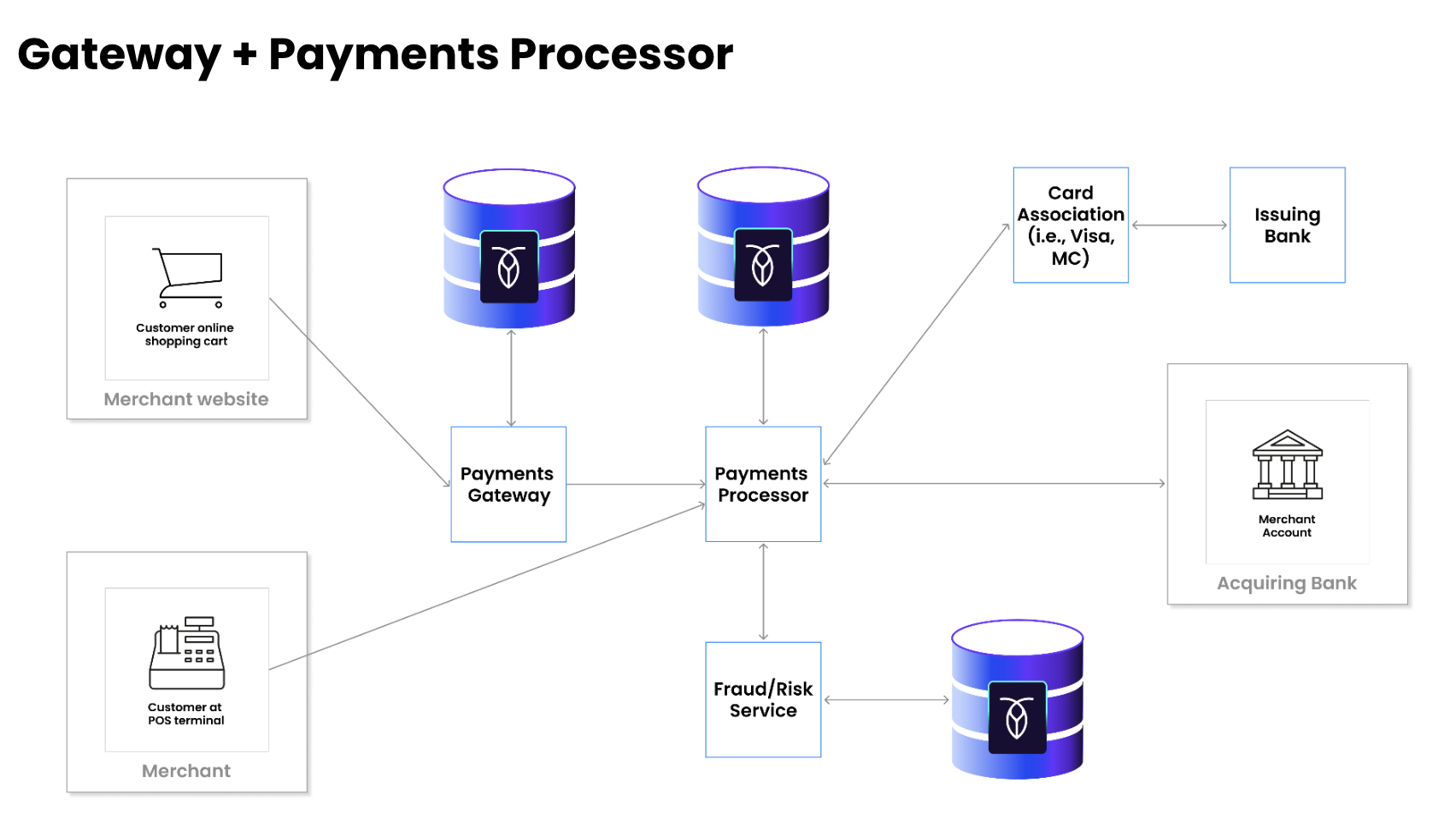
CockroachDB was built to address exactly this intersection of scale, resilience, and strict transactional correctness. It is designed as a distributed SQL database that spreads data across multiple nodes, any of which can process reads and writes. This eliminates the single-leader bottleneck common in traditional deployments and allows horizontal scale simply by adding nodes, without manual sharding.
Strong consistency is enforced across the cluster, ensuring that every region sees the same correct view of the data. For payment and fraud systems, this guarantees that decisions are made against an accurate ledger, regardless of where transactions originate.
Resilience is built into the architecture. CockroachDB supports multi-active availability, meaning the system continues operating even if individual nodes, availability zones, or entire regions fail. It delivers 99.999% availability with zero RPO and near-zero RTO, capabilities that are essential for mission-critical financial applications.
Operational simplicity is equally important. Schema changes, upgrades, and maintenance can occur without taking the database offline. PostgreSQL compatibility ensures familiarity for development teams while avoiding the complexity of manual sharding. Built-in changefeeds help maintain data correctness downstream, supporting analytics, compliance reporting, and event-driven architectures.
Supporting the Future of AI-Driven Payments
The payment ecosystem is rapidly evolving toward instant, tokenized, API-first architectures, with AI transforming routing and fraud detection. Modern fraud systems increasingly incorporate vector embeddings and similarity search to detect patterns that traditional rules might miss.
CockroachDB supports vector search and distributed vector indexing alongside transactional data, enabling fintech teams to combine real-time OLTP workloads with AI-driven fraud analysis in a single, globally distributed system. This eliminates the need to maintain separate databases for transactional and AI workloads, simplifying architecture while preserving performance and correctness.
Future-Proofing Fintech Infrastructure
Fintech leaders — whether CTOs, chief architects, or founders — are often motivated by prior experiences with outages or scaling failures. They understand that infrastructure decisions directly impact customer trust and revenue.
Future-proofing a fintech platform means building on a foundation that can:
Scale horizontally with demand
Survive regional failures without data loss
Enforce 100% transactional correctness
Expand into new markets while respecting data residency requirements
Support emerging AI-driven fraud and automation workflows
CockroachDB provides a globally distributed, cloud-native database built specifically for these demands. In an industry where trust is fragile and competition is relentless, resilient infrastructure is not just an operational concern — it is a strategic advantage.
If payments are the heartbeat of fintech, your database must be engineered to never miss a beat.
To learn more, check out this webinar on "Scaling payment systems with real-time fraud detection," featuring Jim Hatcher and Shannon Dew, both Principal Sales Engineers at Cockroach Labs.