
As GenAI applications evolve from chat interfaces to autonomous agents, they are also introducing real infrastructure challenges. Model hallucinations, service outages, and scaling limitations are common blockers, especially for enterprise teams trying to move beyond proof of concept.
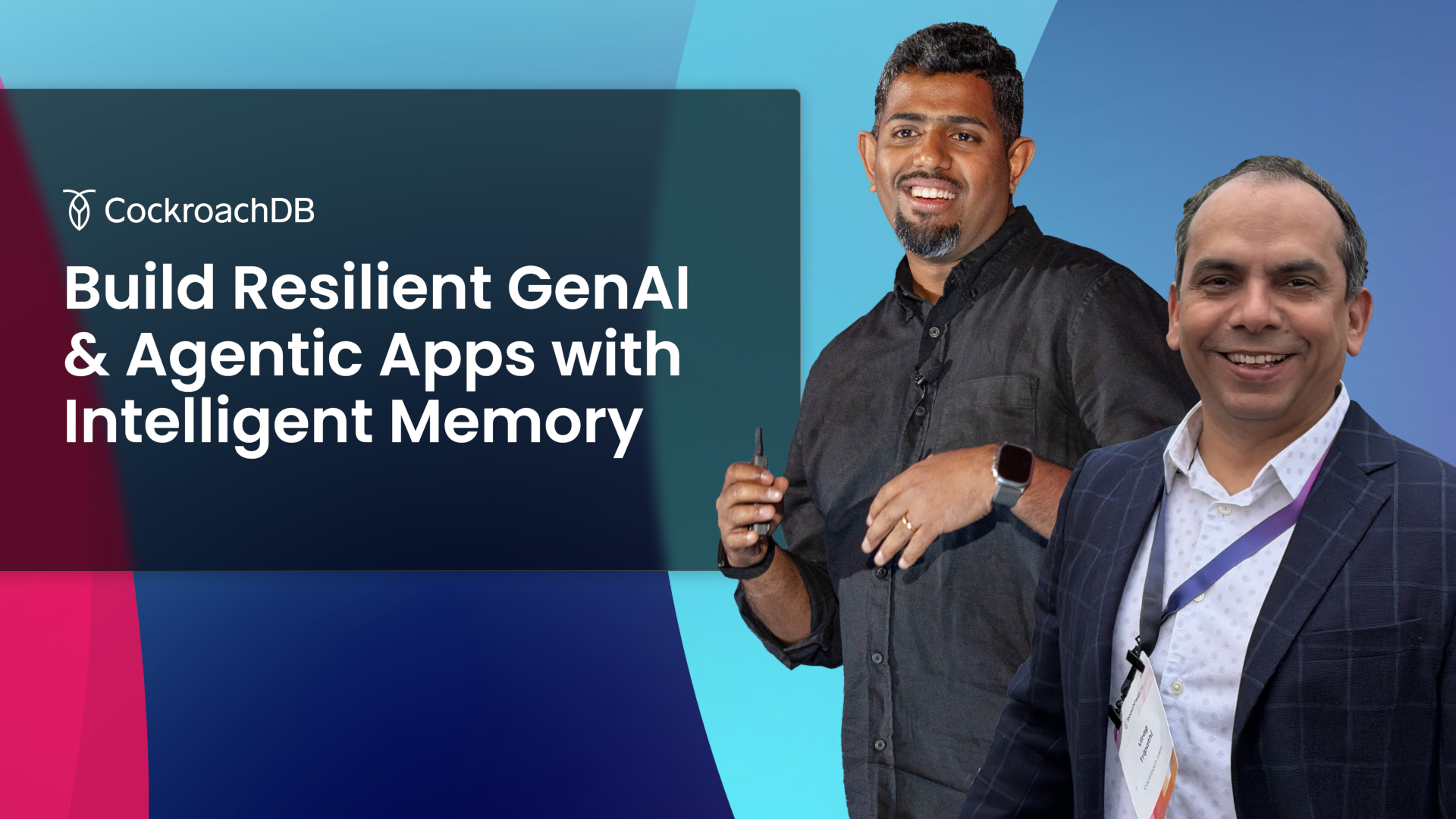
At AWS re:Invent 2025, Cockroach Labs hosted a session titled "Build Resilient GenAI and Agentic Apps with Intelligent Memory." The talk went deep on architecture patterns and showed how to build production-ready GenAI applications with resilience baked in. The message was clear: it’s not just about the model. It’s about how you bring context, tools, and memory together, and do it at scale.
GenAI is reshaping user expectations
The session began with a familiar observation: GenAI has transformed how users engage with software. Instead of typing keywords into a search bar, people now expect direct answers, personalized suggestions, and systems that understand intent. The shift from “search engines” to “answer engines” is well underway.
But there’s a problem. Most enterprise infrastructure was built long before this shift. 70% of companies are still running on legacy systems, and 95% of GenAI initiatives are stuck in proof-of-concept mode. That’s not due to a lack of ambition. It’s because scaling, resilience, and ROI are hard to achieve with outdated tools and fragile architectures.
Three key capabilities for GenAI success
To help teams move beyond the demo phase, the presenters broke GenAI applications into three essential capabilities:
RAG (Retrieval-Augmented Generation) gives large language models access to fresh, contextual data.
Agents perform actions using external tools and workflows, enabling more complex interactions.
Memory allows systems to learn from prior interactions and make future responses more relevant.
Each layer introduces new infrastructure demands. Together, they unlock powerful experiences, but only if the underlying systems can keep up.
A live demo that put resilience to the test
Our team didn’t just talk theory. They showed a live application: a banking assistant powered by GenAI and backed by CockroachDB. This assistant could search expense history, analyze receipts, detect fraud, and personalize recommendations based on user memory.
Under the hood, the system used CockroachDB’s vector search capabilities to handle semantic queries like “What did I spend on coffee last week?” It also used agents to process uploaded receipts and trigger workflows. And it stored long-term user memory directly in the database to improve future responses.
The team went a step further by simulating a real-world failure. They killed off an entire cloud region during a live transaction stream. The database kept serving requests without a hiccup. Transactions continued without errors. The app stayed online.
This wasn’t a disaster recovery plan kicking in after the fact. It was continuous availability built into the architecture.
What made it possible: CockroachDB
The demo ran on CockroachDB, a distributed SQL database designed for resilience and scale. It’s compatible with PostgreSQL, so developers can use familiar tools and syntax. But unlike traditional databases, CockroachDB is built to operate as a single logical system across multiple machines, regions, and even clouds.
Here are a few of the capabilities that stood out:
Horizontal scale without sharding. As demand increases, CockroachDB automatically rebalances data and workloads. There’s no need to re-architect the application.
Always-on availability. Data is automatically replicated across nodes and regions, so services can survive hardware failures, network issues, or entire region outages.
Data locality. Developers can pin data to specific regions, which helps reduce latency and meet data compliance requirements.
Distributed vector indexing. CockroachDB supports high-performance vector search with the ability to isolate and search user-specific data, which helps prevent cross-user data leaks during semantic retrieval.
Put simply, the database makes it easier to build GenAI apps that scale to real-world use cases without compromising consistency, speed, or resilience.
RELATED
Check out Rob Reid, Technical Evangelist at Cockroach Labs, demoing how to build AI data agents with CockroachDB & LangChain:
Build for what’s next
GenAI applications are no longer confined to isolated demos. Teams want to deploy them globally, serve millions of users, and connect them to real systems. That means infrastructure matters a lot.
CockroachDB provides the kind of always-on, always-consistent foundation that these systems demand. Whether you're building a financial assistant, an autonomous agent, or a customer-facing copilot, you’ll need more than a powerful model. You’ll need a database that won’t collapse under pressure.
Want to see how it works?
If you’re starting your journey or looking to upgrade your GenAI stack, Cockroach Labs is hosting a webinar that covers the basics of deploying resilient cloud apps using CockroachDB on AWS.
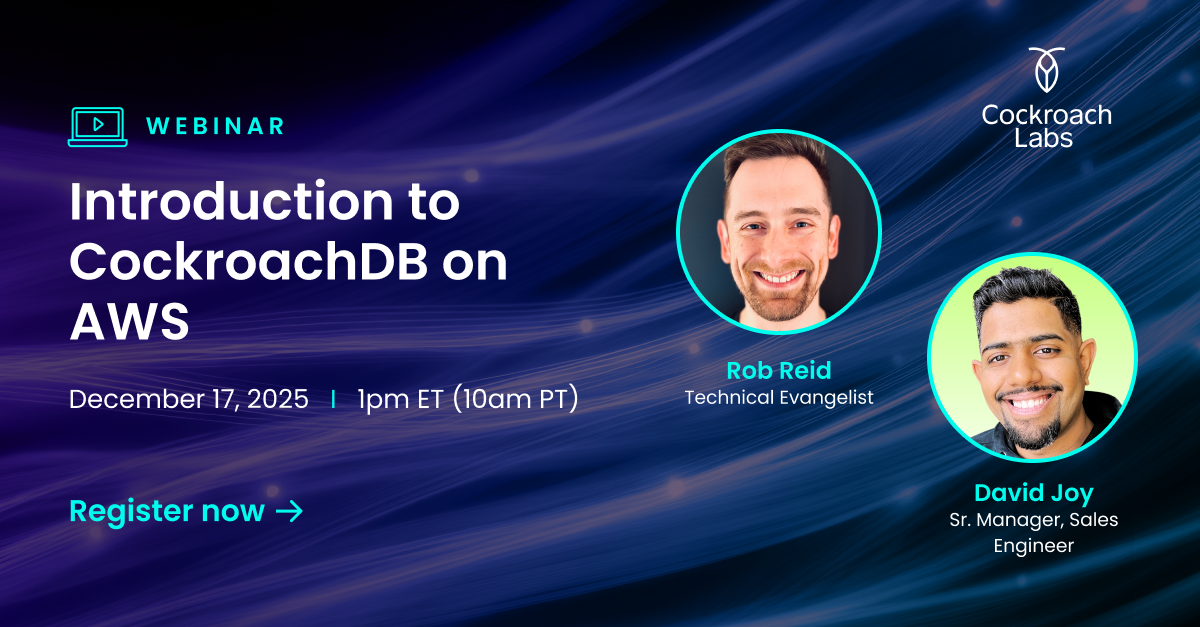
Register on our website.
You’ll get practical tips on architecture, deployment, and how to get started with CockroachDB Serverless on AWS.
Bottom line: You can’t fake resilience. But you can build it into your stack. CockroachDB makes it possible to run GenAI applications that scale fast, survive disaster, and deliver personalized performance, every time.