
Migrating a database is always a high-stakes operation. Downtime, data correctness, data loss, and customer experience are all on the line. Not to mention the business risk if a migration goes poorly. While there are a number of third-party tools that support data migration to CockroachDB, we have the expertise and insights into our product. We knew we could make migrations as efficient as possible in-house.
We built the MOLT (Migrate Off Legacy Technology) toolkit so you can migrate to CockroachDB as simply as possible. With MOLT, we offer the observability, customer support, and scalability that other tools cannot.
MOLT isn’t a single command-line utility. It’s a flexible, modular system designed for real-world migration complexity. From schema translation to row-level verification and live replication, MOLT has you covered.
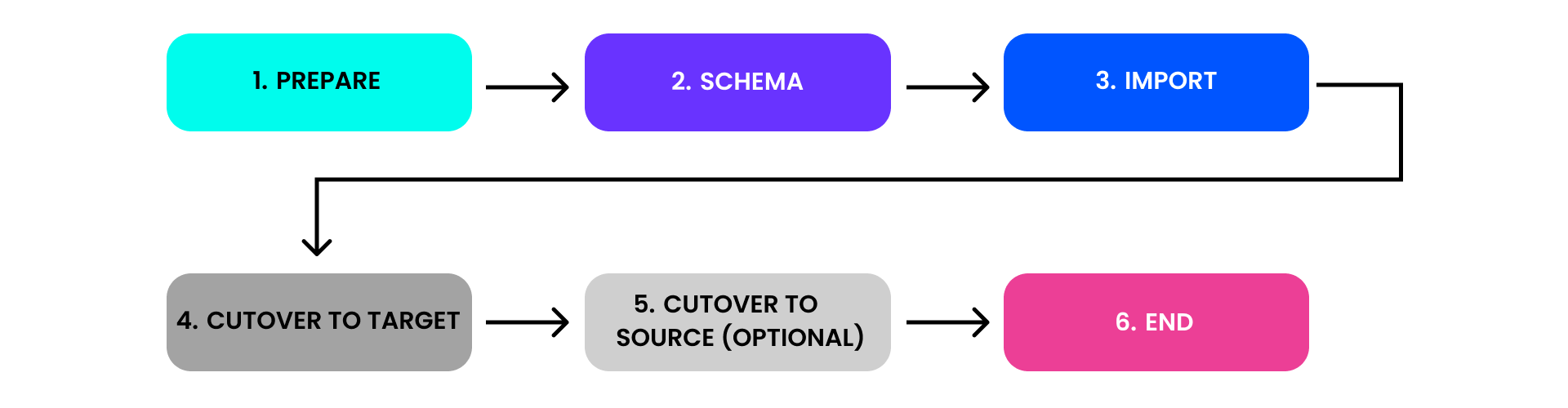
The general workflow is as follows:
#1 Start with a Smart Schema: MOLT Convert
You can’t migrate data until your schema is ready. Unfortunately, converting a legacy schema to work with another database is often the first and most frustrating blocker.
MOLT Convert (aka MOLT Schema Conversion Tool) solves this by parsing your source schema (from Postgres, MySQL, Oracle, or Microsoft SQL Server) and mapping it to CockroachDB. You’ll get:
Warnings about unsupported features
Suggested rewrites for compatibility
An interactive editor with previews and diffs
It’s not just a translator, it’s a learning tool, helping your team build distributed SQL-ready schemas faster and with fewer surprises.
Learn more about MOLT Convert on our blog or check out this video walkthrough below:
#2 Move the Bulk Safely: MOLT Fetch
With your schema in place, the next challenge is moving the data itself. Bulk migrations often involve fragile scripts, long windows of downtime, and little room for error.
MOLT Fetch is built for this moment. It handles large-scale data transfers between your source database and CockroachDB by:
Exporting a stable snapshot from the source
Staging data in cloud or local storage
Importing into CockroachDB via high-throughput options (like IMPORT INTO or COPY FROM)
Resuming after failure using checkpointing
It’s designed for repeatability. Run it once for a dry run. Run it again in production. If something goes wrong, pick up where you left off.
Learn more about MOLT Fetch on our blog or check out how to migrate workloads from Oracle to CockroachDB using MOLT Fetch below:
#3 Keep It In Sync: MOLT Replicator
For teams that need to keep their source database online during the migration or minimize downtime, MOLT Replicator bridges the gap.
Once your initial data is loaded via Fetch, Replicator can stream ongoing changes from the source database to CockroachDB. That means:
You can schedule cutover with minimal downtime
You have time to validate and observe before flipping traffic
Replicator supports logical replication from systems like Postgres and MySQL and works seamlessly with the rest of the MOLT stack. It also supports resumable replication and can be used in rollback or failback scenarios if needed.
This is essential for teams with 24/7 services or regulatory requirements that can’t tolerate even short outages.
#4 Verify Before You Flip: MOLT Verify
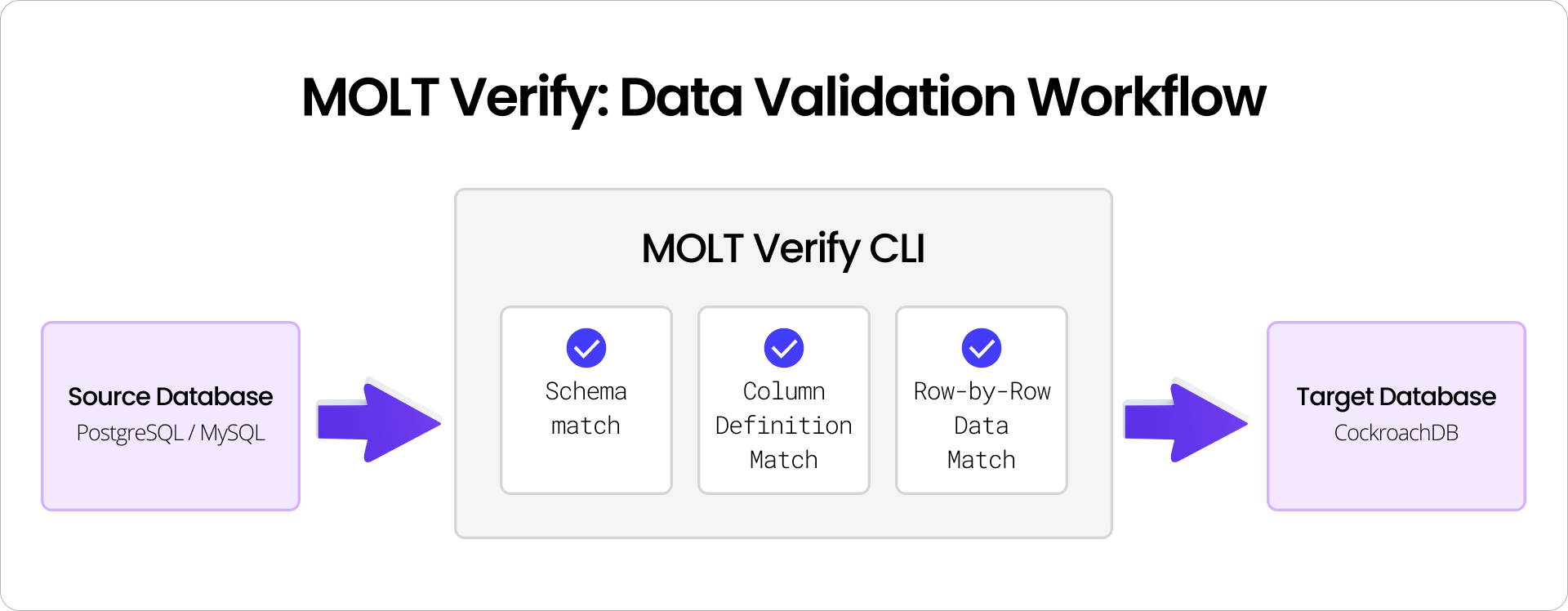
The final step in most migrations is verification. How do you know the data in CockroachDB matches what was in the source?
MOLT Verify gives you that confidence. It checks:
Schema and table verification: are tables, types, and constraints consistent?
Column-level matches: are names, nullability, and types aligned?
Row-level data: is the data itself identical across systems?
MOLT Verify is the migration safety net. It gives you a definitive “yes” (or “no”) on whether your cutover target is ready. There’s no guesswork required.
Learn more about MOLT Verify on our blog.
How It All Comes Together
Each MOLT tool works independently, but they’re most powerful when used together as a migration pipeline:
Translate schemas with MOLT SCT
Load data with MOLT Fetch
Replicate ongoing changes with MOLT Replicator
Validate consistency with MOLT Verify
Cut over to CockroachDB with full confidence
This modularity is intentional. You can mix and match based on your environment, risk tolerance, and migration timeline. Whatever your specific scenario, MOLT adapts. Read more about the different scenarios possible on our docs.
Why MOLT Works for Today’s Enterprise Teams
MOLT isn’t magic, but it is engineered to solve the real pain points we’ve seen time and time again:
Downtime risk: Reduced or eliminated with Replicator
Schema drift and incompatibility: Flagged early by Convert
Fragile bulk loading: Handled by Fetch with checkpointing and observability
Data mismatches: Caught with Verify
Each tool is transparent, and purpose-built for CockroachDB migrations because your database should scale, not your complexity.
Ready to Migrate?
MOLT makes migrations safe, observable, and iterative. That means fewer surprises, fewer fire drills, and more time building what matters. Whether you’re modernizing a legacy app, expanding globally, or moving off a system that just can’t scale, MOLT gets you to CockroachDB without the guesswork.